

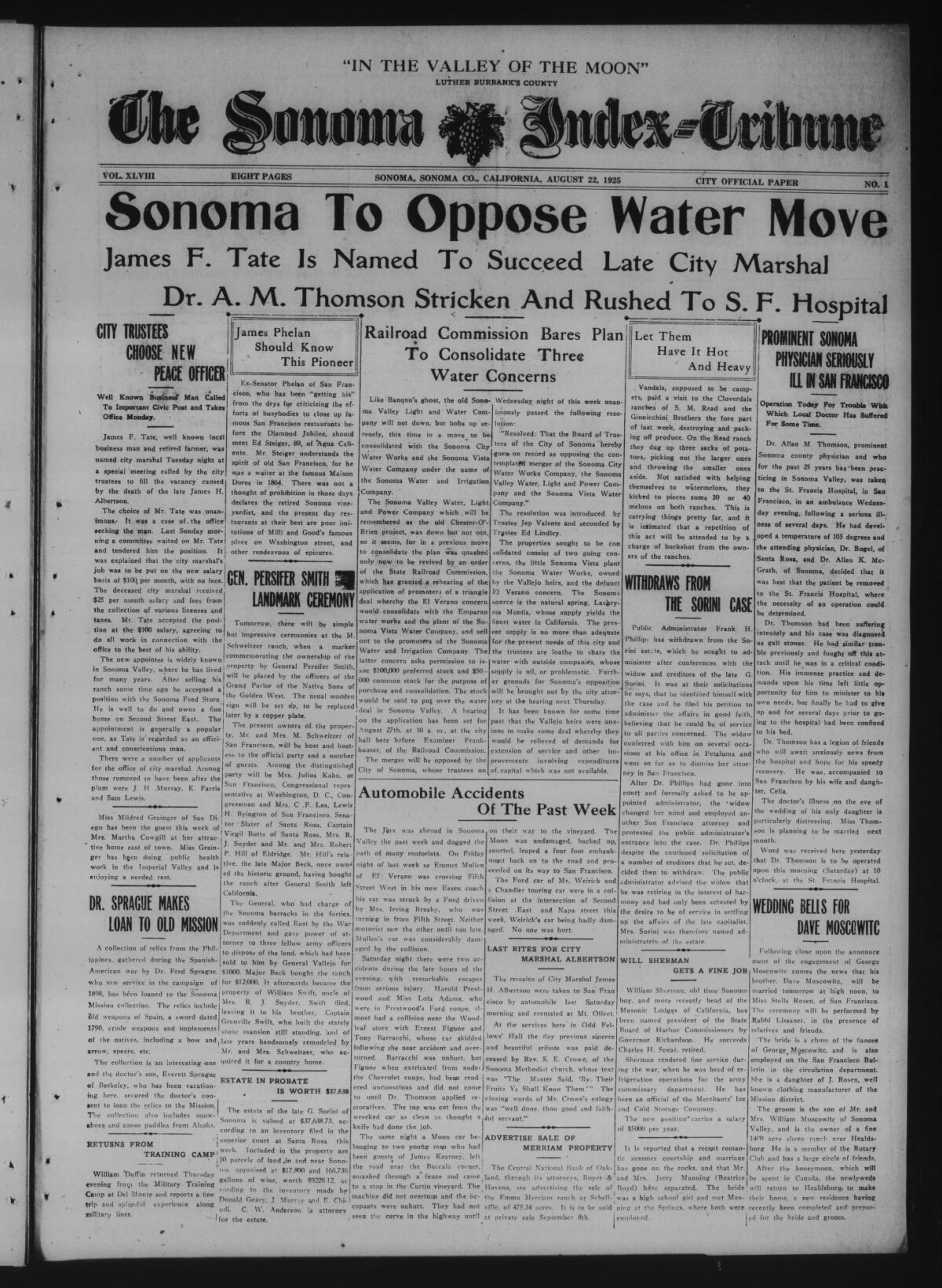
1925 — 101 years ago
From the Sonoma Index-Tribune of August 22, 1925:
The Melon Vandals of Cloverdale. Campers are suspected of dismembering some thirty or forty watermelons on two Cloverdale ranches, having first dug up potatoes and discarded the smaller specimens. The proprietors have intimated that any repetition will be met with a charge of buckshot.
A Marshal Found, Salary Adjusted. James F. Tate, a retired farmer and well-to-do owner of a fine home on Second Street East, was named city marshal after a committee waited upon him on a Sunday morning. He accepted the new flat salary of $100 per month, forgoing the fees his predecessor had drawn.
A Waiter Recalls the Maison Doree. Ed Steiger, 89, of Agua Caliente, who waited at San Francisco's Maison Doree in 1864, declares that present-day restaurants are poor imitations of the old establishments. He notes there was not a thought of prohibition in those days.
Two Years' Labor Yields a Half-Inch Railroad. V. T. Shattock, of the Southern Pacific water service, has built a working miniature railroad to a scale of one-half inch to the foot, laid on tracks inside his outfit car. The engine runs by steam at sixty pounds' pressure, and is accompanied by a tank car, a flat car, a gravel car and a caboose, all correctly numbered and painted.
The Moon That Would Not Overturn. A Moon car belonging to two young men, having failed to see a curve in the highway near the Baccala corner, smashed through a fence and leaped a four-foot embankment. It backed up, snorted, regained the road and continued on toward San Francisco, undamaged and its occupants unhurt.
A Second Wedding Follows Hard Upon the First. Barely has the engagement of George Moscowite been announced than his brother Dave is to marry Miss Stella Rosen at high noon tomorrow. The groom owns a 140-acre sheep ranch near Healdsburg, and the couple will honeymoon in Canada before returning there.
1905 — 121 years ago
From the Sonoma Index-Tribune of August 19, 1905:
Mass Arrives in Glen Ellen, Weather Permitting the Calendar. The faithful of the upper valley are advised that Mass will be said at Mervyn Hall, Glen Ellen, at 11:00 A.M. on the second and fourth Sundays of the month, with an earlier 9 A.M. observance reserved for those rare months blessed with a fifth Sunday. The remaining Sundays, it seems, belong to Sonoma.
A Final Resting Place, By the Grave and the Hour. A dispatch from the Paris suburb of Asnières describes an entire island in the Seine given over to the interment of dogs, where $2.50 leases a grave for three years and includes the services of a uniformed dog undertaker mounted on a tricycle. Those seeking more lasting arrangements may lease a plot in perpetuity for $1000.
Timber Claim Filed, Witnesses at the Ready. Jasper N. Patrick of Napa City has filed sworn statement No. 5528 to purchase Lot 3 of Section 21, arguing the land more valuable for its timber than for the plow. Among the witnesses summoned to vouch for him is one Thomas Willett of Sonoma.
1885 — 141 years ago
From the Sonoma Index-Tribune of August 22, 1885:
A Cautionary Study in the Art of Waiting. A reprinted account from the New York Sun records a gentleman who agreed to meet a client on a street corner, only to find himself watched in turn by policemen, servant girls, a passing tramp, and grinning members of his club, before discovering the whole matter was a misunderstanding about the place of meeting. He concludes that any man capable of waiting on a populous corner for an hour or two at night possesses a stoicism entirely foreign to his nature.
The Undignified Business of Collecting One's Mail. A correspondent describes the Sonoma post office, whose public room measures about 6×10, and the scramble that follows the sorting of the daily mail, in which brute strength generally wins the delivery window. Old people and delicate ladies, having stood in line perhaps for an hour, are reportedly crowded out by new-comers with more muscle and sent back to the end of the line, which by then may extend into the middle of the street.
Local Longevity Held Up as Proof of the Valley's Air. In support of the claim that the Sonoma Valley's climate is conducive to health and longevity, the paper cites citizens who have lived here anywhere from twenty to fifty years and all passed three score years and ten. The majority, it is reported, remain hale and hearty and look as young as they did twenty years ago.
Items retold from the original pages, which are in the public domain; the scans are courtesy of the Sonoma Valley Historical Society collection at the Internet Archive. The century-old OCR is imperfect — where a name or figure was illegible, we have left it out rather than guess.