

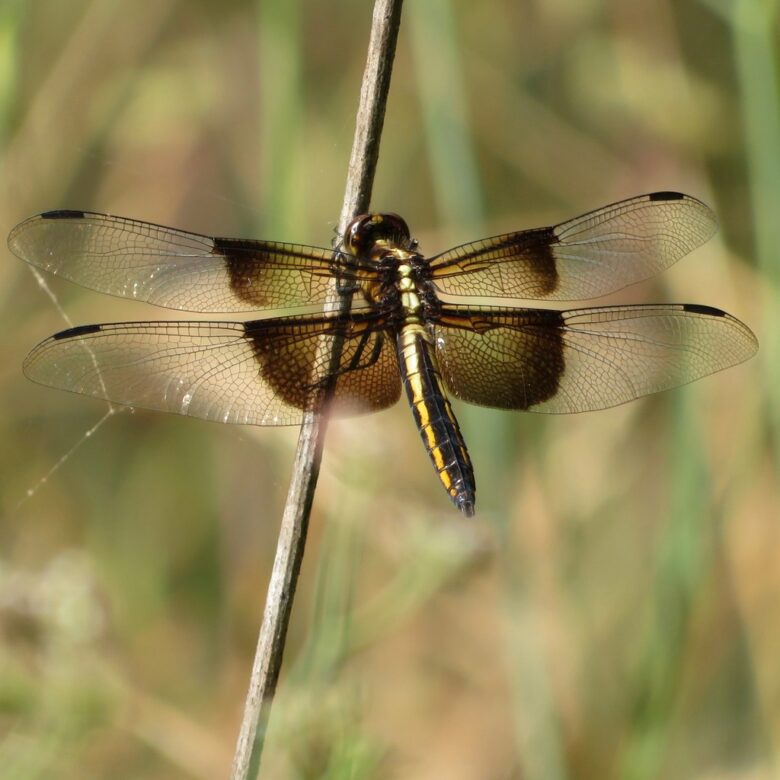
Dragonflies have been turning up in crowds across Northern California this summer, and on Saturday, Aug. 15, a large swarm appeared over Lawndale Road.
Nobody counted them or identified the species. The swarm was the inland end of a line of sightings that runs the length of Northern California.
SFGATE’s Anna FitzGerald Guth traced the same thing up and down the region. Guth found hundreds overhead at a ranch near Smith River, close to the Oregon line, in mid-July. Two weeks later, Guth reported, a swarm appeared over Guerneville, where a mating pair rode the brim of a friend’s hat on a tubing run down the Russian River. The reporting also found squadrons over the grassy hill by Fairyland at Lake Merritt in Oakland. In San Francisco, Recreation and Park staff reported an “unusually large number of dragonflies” over Dolores Park one weekend. On Reddit, r/SanFrancisco and r/bayarea both had versions of the same question: what is with all the dragonflies this year?
Three reasons for a crowd of dragonflies
Three things bring dragonflies out in crowds, and only one of them involves going anywhere.
They are emerging. Lynn Kimsey, professor emerita at UC Davis and former director of the Bohart Museum of Entomology, told SFGATE that eggs laid in water hatch as the days lengthen and warm. The nymphs then leave the water and shed their skins, Kimsey said. That is why adults, underwater as nymphs until then, become conspicuous from June through August.
They are hunting. Kimsey’s distinction settles most sightings. A swarm over a field or grassy ground is feeding, Kimsey said, while dragonflies hovering over water are mating or laying eggs. Chris Grinter, senior collection manager of entomology at the California Academy of Sciences, also spoke to SFGATE. Grinter said cool weather, wind currents and “an abundance of food (mosquitoes)” are the likely drivers of this year’s numbers. Dragonflies are good at it. One can fly at up to 35 mph and catches about 95% of the prey it goes after, often in mid-air. It eats hundreds of mosquitoes, gnats and flies a day.
Or they are migrating. That happens in September and October.
On the evidence, Lawndale Road was the second kind. Migration comes later in the year, and a swarm over a road fits Kimsey’s description of a feeding swarm.
What the valley’s own record says
The Wag’s field guide is built from every research-grade sighting logged inside the valley. For dragonflies it holds 711 observations across 40 species. That is more species in this one valley than the “over 28” usually quoted for the whole Bay Area, which suggests the regional figure is conservative.
| Month | Apr | May | Jun | Jul | Aug | Sep | Oct |
|---|---|---|---|---|---|---|---|
| Share of valley sightings | 20% | 29% | 21% | 11% | 7% | 3% | 1% |
The valley’s record does not quite match the June-to-August emergence window. Sightings peak in May and are well down by August. These are sightings, though, not dragonflies, and May is also when people are out walking with a phone. The same bias runs through the valley’s bird records, where an April–June spike turned out to be birdwatchers rather than birds.
What the table does show is that the Lawndale Road swarm formed while valley sightings were falling. The dragonflies that were left had most likely gathered where the food was.
The autumn passage, and the nine species to watch for
In September and October, dragonflies migrate. They use the same coastal flyway as hawks and falcons. Since 2014, counters at the Golden Gate Raptor Observatory have logged them alongside the raptors over the Marin Headlands, and on one Oct. 8 they recorded 269 Variegated Meadowhawks moving south in a single day.
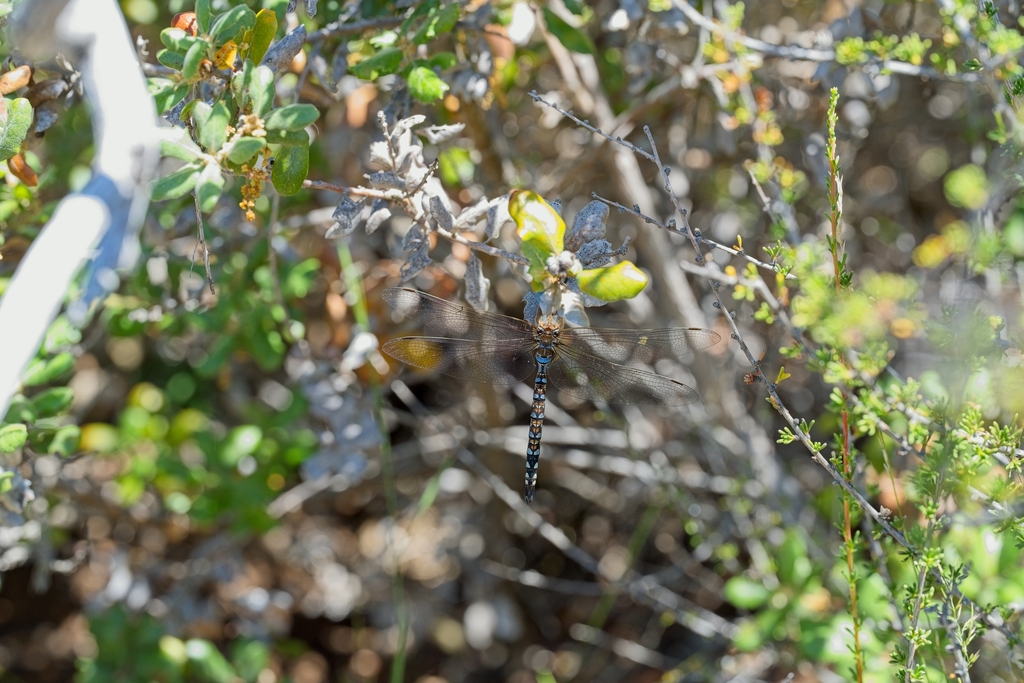
Bay Nature counts at least nine species making that passage, and all nine have been logged in the valley.
| Species | Valley sightings | |
|---|---|---|
| Flame Skimmer | 56 | the big orange one everybody notices |
| Variegated Meadowhawk | 38 | the migration’s headline species |
| Cardinal Meadowhawk | 28 | red, and holds its wings forward |
| Blue-eyed Darner | 12 | |
| Twelve-spotted Skimmer | 8 | |
| Black Saddlebags | 7 | dark patches at the hind wing base |
| Common Green Darner | 4 | the long-distance traveller |
| Spot-winged Glider | 1 | |
| Red Saddlebags | 1 |
Only about 16 of the 326 dragonfly species in the United States migrate at all, and those that do travel far. Common Green Darners average more than 600 kilometers, and individuals have been tracked beyond 2,500. A tenth species is the Wandering Glider, logged once in the valley. It occurs on every continent except Antarctica and crosses oceans.
Where these insects are going, and where they started, is still unknown. Bay Nature says the details along the West Coast “remain subjects of surmise.” Nobody has mapped the route, though the insects fly by day and in plain sight.
If you see one
- Holding station over grass or a road: a feeding swarm. It will move on when the insects do.
- Hovering over water: mating, or laying the eggs that produce next summer’s swarm.
- All moving the same way in September or October: the migration. The Wag would like to hear about it at [email protected].
Either way, log it. Every sighting in the table above came from a resident with a phone camera. The valley’s whole dragonfly record is 711 observations deep, thin enough that one good afternoon on Lawndale Road would move it.
Regional reporting, and the interviews with Chris Grinter, Lynn Kimsey and Daniel Montes, from SFGATE (Anna FitzGerald Guth). Migration counts from Bay Nature. Swarm behavior and migration distances from Bryan Pfeiffer. Valley species counts and monthly figures from the Wag’s field guide, built on research-grade iNaturalist observations inside the valley, retrieved Aug. 16, 2026.