

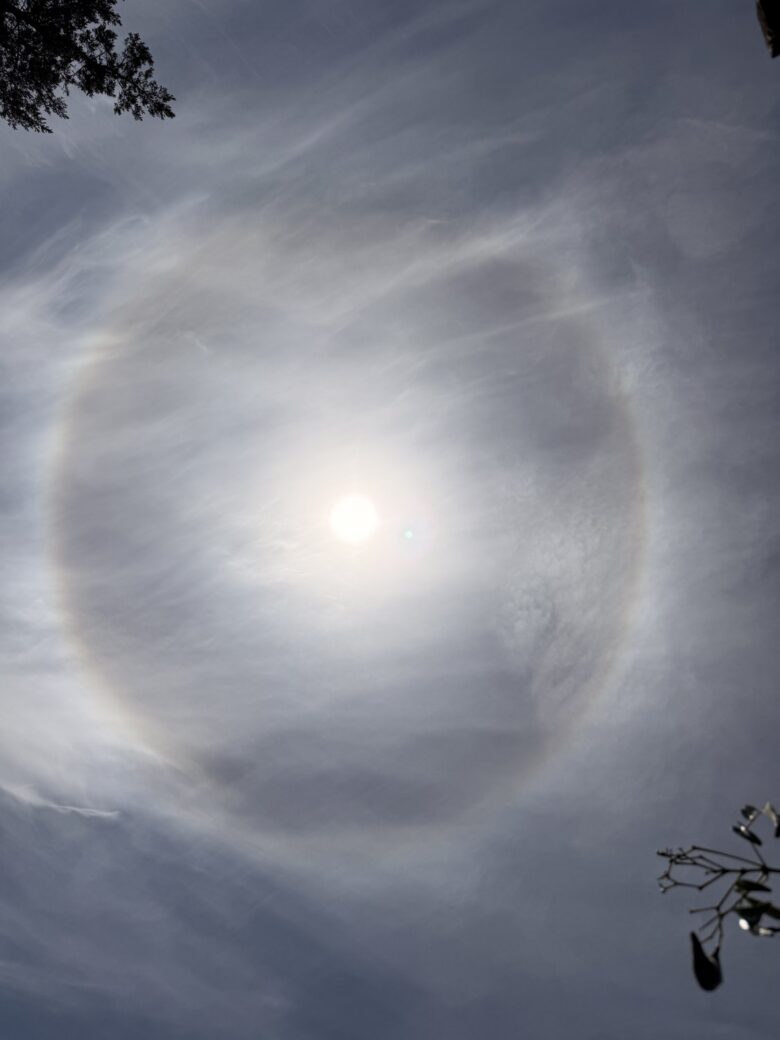
A ring stood around the sun over Kenwood on Saturday, and two bright spots flanked the sun this week. Both are made of ice, and they sit the same distance from the sun.
Start with a trick you can use any time. Hold your arm straight out and spread your hand. The span from thumb tip to little-finger tip is about 20 degrees of sky, close to the radius of the ring in the photograph.
The ring never changes size, whatever the season, the weather or where you stand. Every ring like this one sits about 22 degrees out from the sun.
Six-sided ice
Five miles up, clouds are made of ice rather than water. The crystals are six-sided. Some are long, like a pencil, and some are flat plates, and the six sides are what fix the size of the ring.
A 60-degree prism
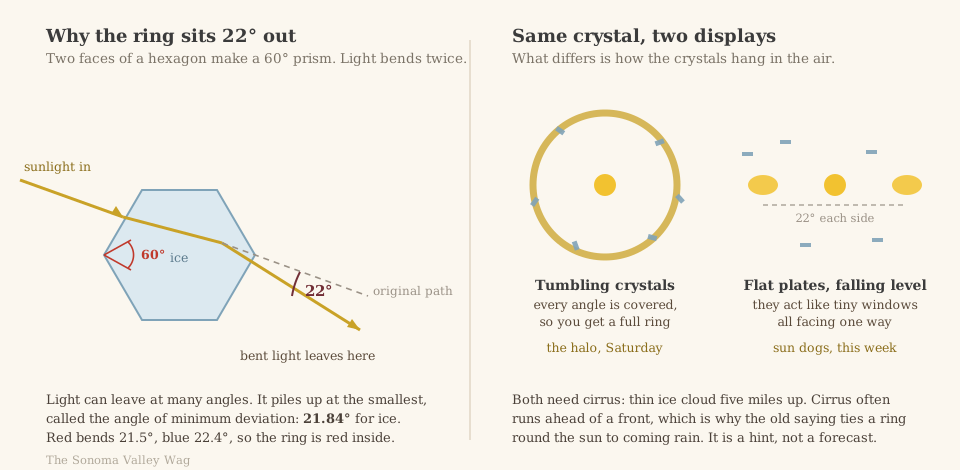
Take a six-sided pencil. Pick one flat face, skip the next and take the one after that. Those two faces lean away from each other at 60 degrees.
A 60-degree wedge of clear material is a prism. Light bends when it enters and bends again when it leaves, as anyone who has held a glass prism up to a window has seen.
Why the light piles up at 22 degrees
How far the light bends depends on the angle the crystal happens to be sitting at. Up in the cloud the crystals sit at every angle, so light leaves them at all sorts of angles, and you might expect a smear of light rather than a ring.
Two things prevent that. One is a floor. However you turn the crystal, the light will not bend less than about 22 degrees, though it can bend more.
The other is what happens near that floor. Close to that minimum, tilting the crystal a good deal barely changes the bend, so a whole range of crystal angles all send light out at close to 22 degrees. It works like a ball in a valley with a wide, flat floor, which ends up at the bottom wherever it starts on the slopes.
So the light spreads thin at wider angles and stacks up near 22 degrees. That stack is the ring you see.
Why the inner edge looks rusty
Red light bends the least and blue light the most. The gap is small, about a degree, but it is enough to put red on the inside of the ring and blue on the outside. That is the reverse of a rainbow, where red rides the outer edge, and it is why the inside rim of a bright halo carries a faint rust color.
The two bright spots are the same ice, hung differently
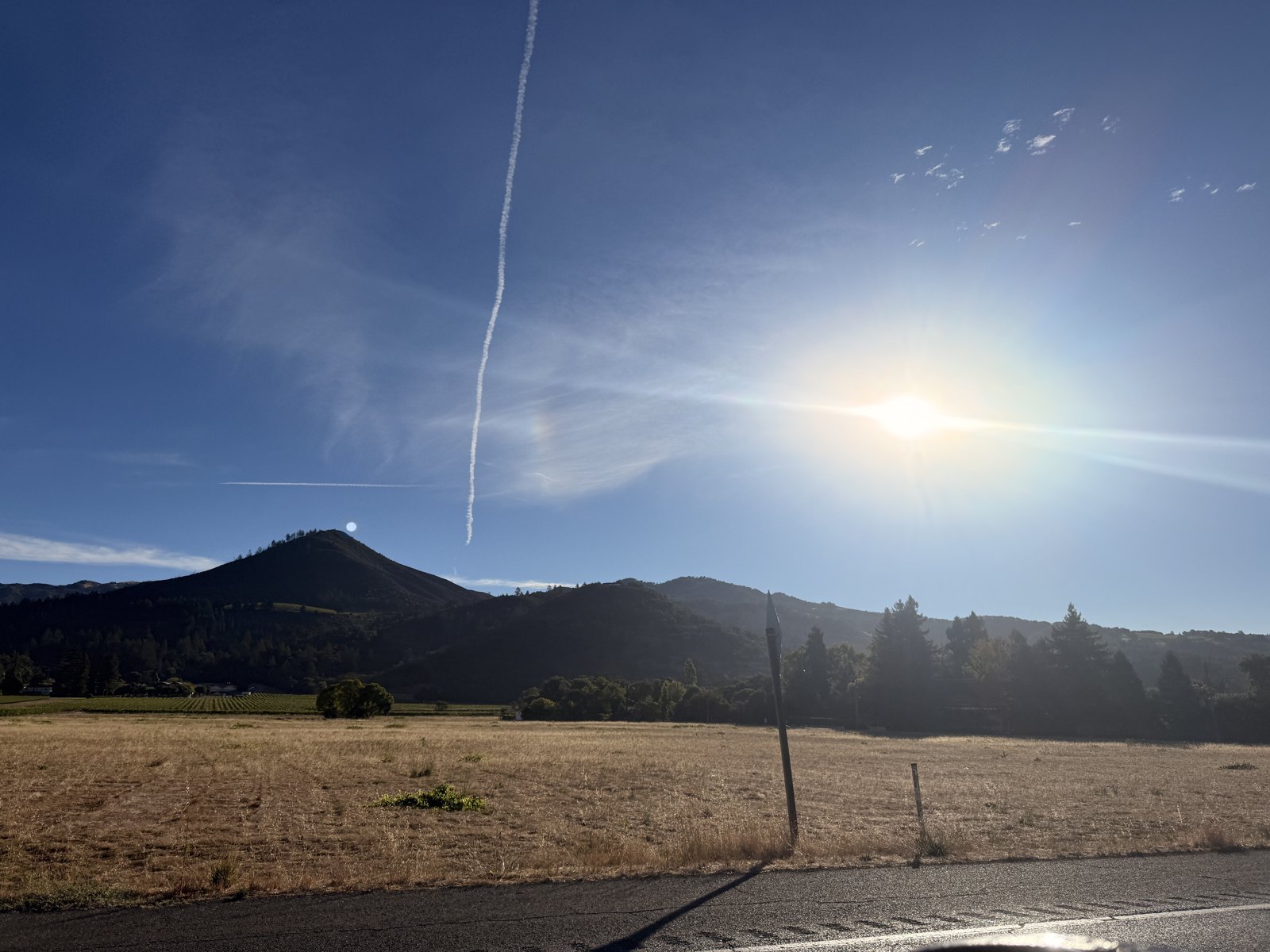
Sun dogs, which the books call parhelia, sit to the left and right of the sun at that same 22 degrees. The ice and the wedge are the same as in the ring. Only the way the crystals hang is different.
A full ring needs crystals tumbling every which way, so that every angle is covered and light arrives from all around the sun.
Sun dogs need flat crystals, wide and thin, drifting down level, like leaves settled flat on a pond. Because they all face the same way, you get two bright patches, one on each side of the sun, instead of a ring.
Does a ring mean rain
Sometimes. The high ice cloud that makes halos often runs a few hundred miles ahead of a warm front, so a ring can turn up a day before the weather does. That is the mechanism behind the old saying. The same cloud also drifts over on plenty of days that stay dry, so treat a ring as a hint. Our dashboard carries the actual forecast.
One more to look for
There is a second, bigger ring. It uses a different pair of faces, which meet at a right angle instead of 60 degrees, and it sits about twice as far out. It is fainter and much rarer.
Both photographs were taken in Kenwood this week. If you catch one, send it to [email protected] and we will run it.